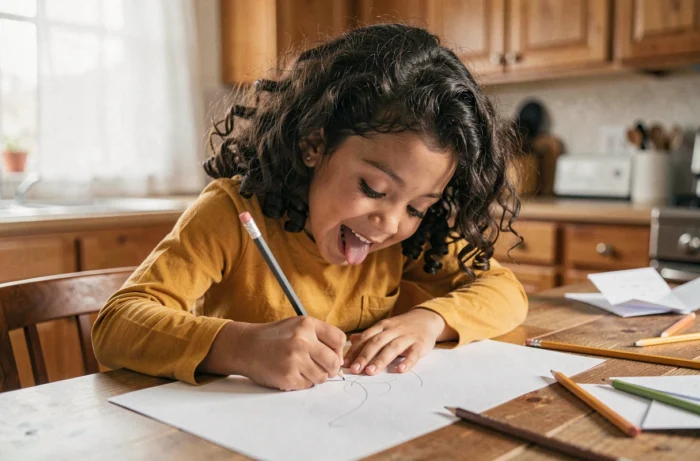
A rainy Sunday, a blank sheet of paper, and a pencil placed on the kitchen table are enough to keep a child occupied for an hour. No batteries, no connection, no instructions: games with paper and pencil engage children’s creativity with materials that every household already possesses. Their simplicity is deceptive, as behind a pencil stroke lie cognitive mechanisms that deserve attention.
Adult’s Role During Paper-Pencil Play: Directing or Supporting
You may have noticed that the same drawing game can yield very different results depending on how the adult intervenes? A protocol published in September 2026 in the journal Frontiers in Sociology (Lalnunmawii and Gangadgaran) distinguishes two modes of support: directed activity and free exploration.
In the directed mode, the adult gives a precise instruction (“draw a house with three windows”). The child executes. They progress in fine motor skills, but their imagination remains subdued.
In the exploratory mode, the adult asks open-ended questions: “What could live in this shape?” or “What if you added a character?”. The child decides the outcome, the adult nourishes the process. This type of interaction, termed “responsive” by researchers, encourages the child to take graphic initiatives without fearing mistakes.
In practice, this changes how one proposes an exquisite corpse or a drawing to complete. Instead of showing a model, one describes a situation (“an animal that flies but has no wings”) and lets the pencil decide. To delve deeper into this approach, the games offered by Le Chaudron Des Jeux detail the benefits of this supportive posture on children’s creativity.
Paper and Pencil Games Suitable for Every Age Group
Not all games require the same skills. A four-year-old does not play the small bac, and a preteen quickly gets bored with free coloring. The choice of game must correspond to the stage of development.
Before Six Years: Free Drawing and Guided Scribbling
At this age, the gesture matters more than the result. Drawing spirals, connecting dots, inventing shapes without naming them: these activities enhance hand-eye coordination. An effective game involves drawing an abstract shape and then asking the child what they see. It is they who give meaning to the drawing, not the other way around.
From Six to Nine Years: Games with Simple Rules
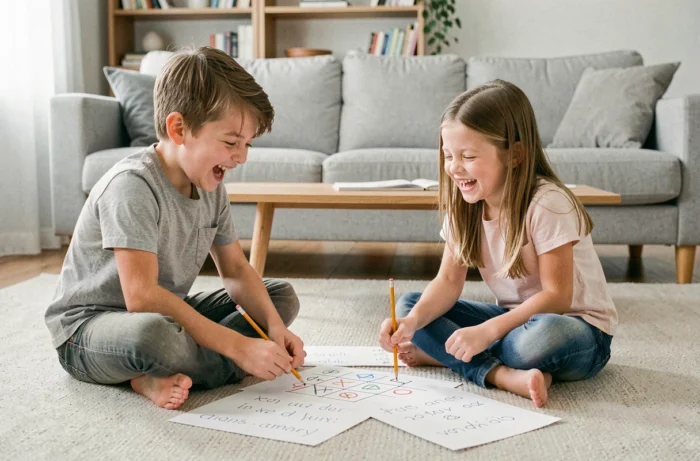
Tic-tac-toe, dots and boxes (connecting dots to form squares), or hangman work well. These games introduce the concept of strategy. The child anticipates, plans a move, accepts losing. With graph paper, one can also invent mazes for a friend to solve.
After Nine Years: Narrative Creation and Collaborative Drawing
The exquisite corpse (each player draws a part of the body without seeing the rest) or the “headless” game (writing a sentence, folding, passing to the neighbor) mobilizes collective creativity. The child learns to cope with the unexpected, as the outcome also depends on other players.
Safety of Creative Supplies for Children
It is rarely considered, but crayons, markers, and watercolors placed in a child’s hands may fall under European regulations on toy safety. The EN 71 standard particularly governs the migration of certain chemical elements present in play materials, including coloring supplies.
The European Union also updated its harmonized standards in 2026 to strengthen manufacturers’ compliance.
In practice, here’s what to check before allowing a child to draw freely:
- The CE marking on the packaging of crayons and markers, which certifies compliance with European toy safety standards
- The mention of the recommended age range, especially for toddlers who put objects in their mouths
- The absence of small detachable parts (marker caps, pencil tips) that could pose a choking hazard for children under three years old
Paper and Pencil as a Structured Alternative to Screens
Proposing a drawing game “to reduce screen time” is a common idea. Research published in 2026 in Frontiers in Sociology goes further. It recommends not just removing the screen, but replacing digital use with a supported creative activity.
The difference is notable. Placing a sheet and crayons on the table and then stepping away is free play. It is useful, but the child often returns to the screen within minutes due to lack of stimulation. In contrast, sitting with them, proposing a game (even five minutes of tic-tac-toe), and then letting them continue alone with the materials creates a bridge between guided activity and autonomous exploration.
Sorting activities with images cut from magazines, mentioned in this same research, illustrate this principle well. The child cuts, sorts, glues, and invents a story from the images. Paper becomes a medium for storytelling, not just a simple screen substitute.
Three Lesser-Known Variants of Paper-Pencil Games
Competitors often cite the same classics. Here are three variants that refresh the genre:
- The reverse dictated drawing: the child describes a drawing they have in mind, and the adult draws following their instructions. This exercise works on spatial vocabulary (to the left, above, bigger) and reverses the usual dynamic
- The shared treasure map: each player draws a part of an imaginary island on the same sheet, respecting the elements already placed by others. The result is a common world, negotiated stroke by stroke
- The blind portrait: drawing another player’s face without looking at their sheet. The result, always funny, de-dramatizes mistakes and relieves the pressure of “drawing well”
These variants share a common point: they place communication and imagination at the center, not graphic performance. A child who does not like to draw may very well love dictating a drawing or inventing a map.
Paper and pencil remain among the most accessible and versatile creative tools. Their value does not lie in the materials themselves, but in what we do with them, and especially in how we support the child in their exploration.