
The EDF webmail allows employees and clients with professional access to check their messages from any connected workstation. This flexibility raises a practical question: how to protect your credentials and personal data when connecting outside the usual network, on hotel Wi-Fi, a shared computer, or a personal smartphone?
Real Risks of Remote Access to Professional Email
Most guides on the subject focus on how to connect. The problem starts afterward. Remote access multiplies the points of vulnerability that are not encountered in the office.
The first risk factor remains the network used. Public Wi-Fi, in a coworking space or an airport, exposes traffic to interception if the connection is not end-to-end encrypted. The HTTPS protocol protects the exchange between the browser and the server, but it does not cover vulnerabilities related to the device itself.
The second factor concerns the device. On a shared computer or a self-service terminal, the browser may retain session cookies, an input history, or automatically saved credentials. A subsequent user can then access the account effortlessly. Security recommendations emphasize session hygiene while mobile: closing the browser after use, disabling automatic password saving, and clearing the cache.
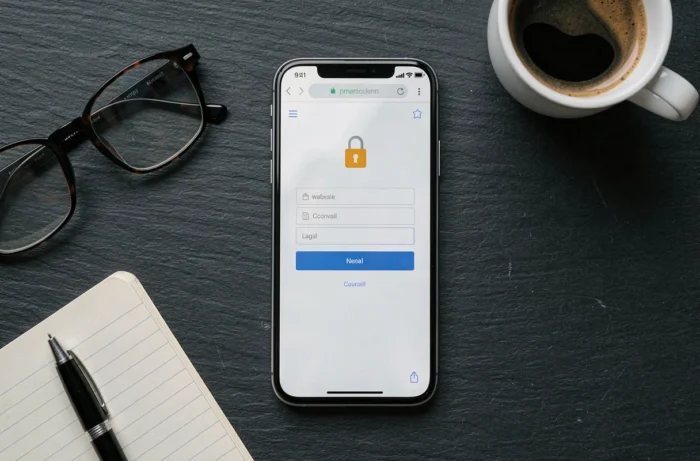
To access EDF Webmail securely, it is essential to address the problem at the source, that is, even before entering your password.

Phishing Targeting EDF Mailboxes: An Increasing Vector
Email remains a primary target for attackers. Phishing campaigns regularly impersonate EDF to entice users to click on a fraudulent link leading to a fake login page. The principle is always the same: replicate the webmail interface to capture credentials.
The most effective and underestimated countermeasure is a simple action: type the official address directly into the browser’s address bar instead of clicking on a link received via email. This simple reflex cuts off almost all attempts to redirect to a counterfeit site.
Recent alerts regarding energy check scams confirm that EDF’s name is frequently used as bait in fraudulent emails and calls. The same pattern applies to fake maintenance messages from webmail inviting users to “update their terms of use” or “confirm their account.”
Warning Signs to Spot in a Suspicious Email
- The sender uses a domain that does not exactly match EDF’s official addresses (a modified letter, an unusual subdomain).
- The message contains artificial urgency: imminent account suspension, data deletion within 24 hours.
- The link in the body of the email points to a different URL than the one displayed, verifiable by hovering over the link without clicking.
- Syntax errors or inconsistent formatting betray automated production.
Two-Factor Authentication and Password Management Remotely
Two-factor authentication (or multi-factor authentication) is the most concrete protection lever for remote access. The principle adds a step after entering the password: a temporary code sent via SMS, generated by a dedicated app, or validated by notification on a trusted device.
Recent official recommendations emphasize activating this mechanism as soon as possible, especially for sensitive accounts like professional email. In case of credential theft through phishing or network interception, the temporary code blocks access to the account since it changes with each attempt.
Password: The Rules That Really Matter
Using a unique password for EDF webmail, distinct from that of other services, remains a basic measure. However, the length of the password takes precedence over its apparent complexity. A passphrase of four or five random words withstands brute-force attacks better than a short sequence of special characters.
Password managers (integrated into the browser or via third-party software) allow storing these long credentials without needing to memorize them. On a shared device, this option should be disabled: no saved passwords, no session kept open.
GDPR Framework and Rights Regarding Data Processed by EDF
EDF processes personal data as part of its activities, in compliance with Regulation No. 2016/679 (GDPR) and Law No. 78-17 of January 6, 1978, as amended. The details of the processing vary depending on the relationship with EDF: customer, prospect, candidate, or simply an internet user browsing its sites.
For individual and professional customers and prospects, EDF specifies the purposes of collection, retention periods, and data recipients. Information collected through online forms is subject to specific mentions, and cookies deposited during browsing are detailed in the dedicated policy.
Exercising Your Rights in Practice
The GDPR guarantees a right of access, rectification, deletion, and portability of data. For the EDF OA chatbot, for example, conversational data is retained for 60 days and then anonymized. Only the email address and IP address are maintained in case of a deletion request, for a duration of five years.
Exercising these rights does not require any particular justification. A written request to EDF’s data protection officer is sufficient. The response must occur within one month, extendable in case of a complex request.
Protecting your data while accessing EDF webmail remotely relies on simple but non-negotiable technical gestures: check the URL, enable two-factor authentication, never save your credentials on a shared device. The regulatory framework offers concrete rights regarding collected data, but the first line of defense remains the user’s behavior at the time of connection.