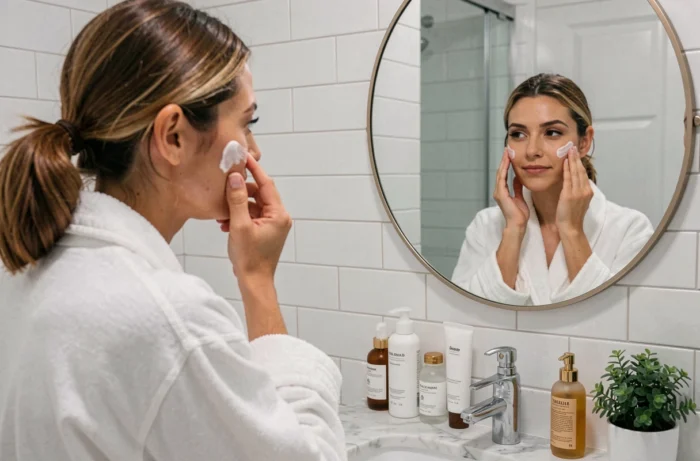
Your skin feels tight after the shower, your hair is dull despite treatments, and fatigue shows on your face by midday. These signals often indicate poorly calibrated actions or habits that sabotage your efforts without you realizing it.
What European regulations change for your skincare products
Before discussing routines, the composition of your cosmetics is changing. Regulation (EU) 2026/909, published on April 27, 2026, modifies the annexes of Regulation (EC) No. 1223/2009 and prohibits or restricts twelve substances in cosmetics sold in Europe.
Among these substances, triphenyl phosphate (TPP) is now formally banned. The available data did not allow for the exclusion of potential genotoxicity. Benzyl salicylate, a common allergen in fragrances, has its maximum allowed concentration lowered, this time for endocrine disruption reasons.
In practical terms, this means that some products you use today will be reformulated in the coming months. Checking the INCI list on the back of your bottles is no longer a luxury; it’s a way to spot formulations that are already compliant. Resources like soins-beaute-sante.fr help track these changes and adjust your skincare choices accordingly.

Skin hydration: the step that most people do too late
Have you ever noticed that your moisturizer seems less effective on certain days? The problem rarely lies with the product. Hydration happens within three minutes after cleansing, when the skin is still slightly damp and the skin barrier remains permeable.
Applying a treatment on already dry skin is like putting a film on a surface that has lost its ability to absorb. The product stays on the surface, greasing without hydrating.
How to adapt the step to your skin type
On oily skin, prefer a watery serum before the cream. On dry skin, an occlusive balm applied on damp skin retains water longer than a rich cream applied on dry skin.
A common mistake with combination skin is to only hydrate the dry areas. The T-zone produces excess sebum precisely because it lacks water. Hydrating the oily area reduces sebum overproduction, which may seem counterintuitive but works.
- Dry skin: sulfate-free cleanser, then balm on damp skin, morning and night
- Oily skin: gentle cleansing gel, lightweight hydrating serum, non-comedogenic fluid cream
- Sensitive skin: alcohol-free micellar water, soothing cream with the minimum of active ingredients
Diet and skin: the concrete links that cosmetics cannot replace
No cream can compensate for an unbalanced diet. The skin is an organ, the largest in the human body. It constantly renews itself and uses what you provide from the inside.
An excess of sugars and animal fats amplifies the appearance of pimples. Additionally, excessive consumption of fatty foods contributes to the production of free radicals, which alter skin elasticity over the long term.
What works without expensive supplements
Instead of listing trendy superfoods, focus on two simple levers. The first: drink enough water throughout the day, not just in the morning. The second: incorporate colorful vegetables (carrots, peppers, spinach) into every meal. Their richness in antioxidants protects skin cells.
Sleep plays a comparable role. Most adults need seven to nine hours per night to allow cells to regenerate properly. Sleeping less than six hours visibly accelerates skin aging.

Stress and skin health: an underestimated link
Chronic stress triggers a hormonal cascade that increases cortisol production. This cortisol stimulates sebaceous glands, promotes inflammation, and slows healing. The result: acne breakouts, dull complexion, pronounced dark circles.
Why is this link underestimated? Because beauty and mental health are still often separated into two distinct categories. Stress management is a skincare treatment in its own right.
Actions that affect both body and mind
Daily walking, even for twenty minutes, improves blood circulation and oxygenation of skin tissues. Regular physical activity reduces cortisol and promotes endorphin production.
- Incorporate gentle physical activity (walking, yoga, swimming) several times a week to reduce cortisol
- Limit screen exposure before bedtime to improve sleep quality
- Practice abdominal breathing for a few minutes each day, a free action that directly affects the nervous system
Tobacco also deserves mention. It alters collagen metabolism and leads to premature skin aging with wrinkle formation. Quitting smoking remains the most effective anti-aging action, far beyond any serum.
Caring for your beauty and health is not just about piling products in a bathroom. Hydrating on damp skin, incorporating colorful vegetables into every meal, sleeping seven hours, and walking twenty minutes a day have a more lasting effect on the skin than most serums. And since 2026, ensuring that your cosmetics comply with the new European restrictions adds a layer of protection that your skin cannot negotiate alone.