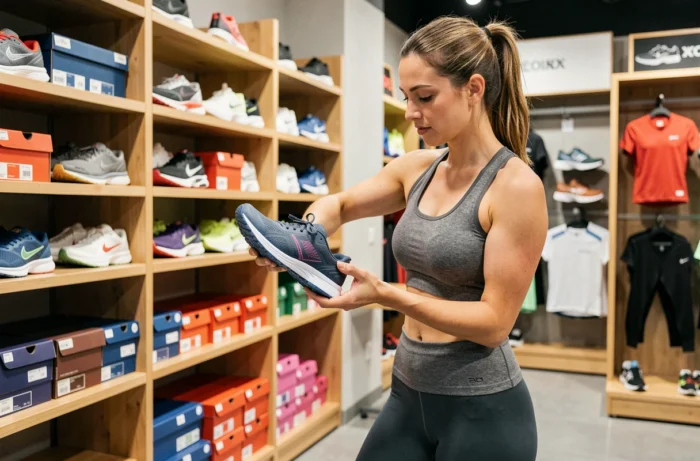
Choosing sports equipment involves balancing several measurable parameters: cushioning, weight, breathability, durability, compatibility with a body type or activity. The performance gaps between two products of different ranges do not always lie where one might think. This article compares the criteria that truly impact progress and injury prevention, backed by data.
Sports textiles: composition and durability as selection criteria
Most guides advise to “prioritize quality.” The problem is that the quality of a sports garment is reflected in its composition, not its price.
A quick-drying synthetic fabric (recycled polyester, polyamide) wicks sweat more effectively than even thick cotton. Breathability depends on the weight and weave, two data points rarely displayed in stores.
Since October 1, 2025, the voluntary display of the environmental cost of clothing is possible in France. The calculation includes materials, manufacturing, transport, end-of-life, and certain dimensions of durability. To compare two sports outfits, it becomes relevant to check the detailed composition, reparability, and usage duration rather than relying on a generic label.
The product sheets on format-sport.com allow for cross-referencing these technical parameters before a purchase, which helps avoid ending up with a jersey that pills after three washes.
| Textile Criteria | What to Check | Impact on Practice |
|---|---|---|
| Composition | Percentage of synthetic vs natural fibers | Sweat wicking, drying time |
| Weight | Fabric density (light for summer, denser for winter) | Thermoregulation, long-lasting comfort |
| Reparability | Reinforced seams, availability of spare parts | Longevity, actual cost over several seasons |
| Environmental Display | Score or detailed sheet (materials, transport, end-of-life) | Comparability between brands since October 2025 |
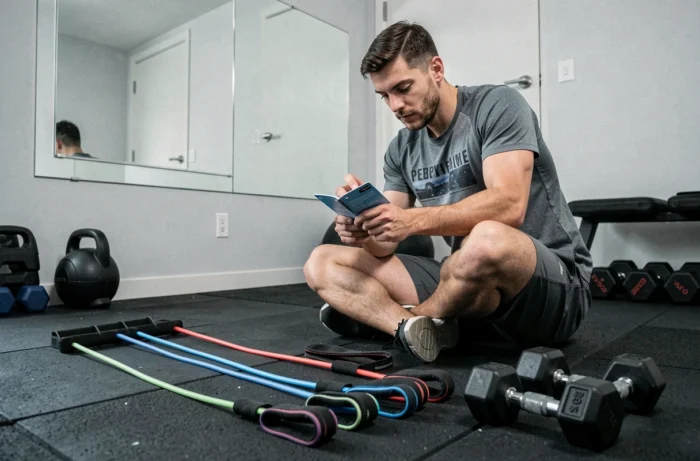
Sports shoes: the variables that truly change the stride
Shoes account for the majority of the budget for land sports (running, hiking, football). The gap between a suitable model and an unsuitable one is measured in terms of injuries avoided, not just in perceived comfort.
Cushioning and Stride Type
A pronating runner and a supinating runner do not stress the same areas of the sole. Choosing a shoe without knowing one’s stride type is like buying glasses without a prescription. Several brands offer free stride analysis in-store.
Cushioning should be calibrated according to the runner’s weight and training frequency. A highly cushioned model is suitable for long road runs, while a stiffer model with studs is necessary for trail running or hiking.
Shoe Weight and Practice Terrain
For football, the lightness of the shoe influences kicking speed and responsiveness. In hiking, the stability of the upper (high or low) takes precedence over weight. The choice depends on the terrain:
- Road or flat track: light shoe, flexible sole, generous cushioning to absorb repeated impacts
- Technical trail or mountain: cleated sole, high upper for ankle support, abrasion-resistant materials
- Synthetic or grass surface (football): molded or screw-in studs depending on the surface, shoe fitted to the foot for ball control
A single athlete may need two distinct pairs if alternating surfaces.
Connected equipment: measuring what helps in decision-making
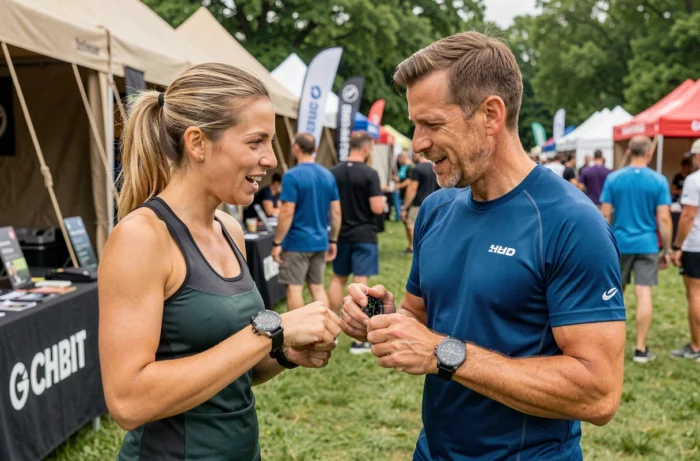
Watches, heart rate sensors, and other connected accessories have multiplied. Their real interest depends on how they are used.
A recent study conducted with elite volleyball players linked individualized training supported by connected devices to a improvement in vertical jump and flight time. However, the effect on ground contact time was not statistically established. The wearable does not transform performance by itself: it transforms it when used to adapt training.
Choosing a sensor based on the decision it enables rather than the number of metrics displayed remains the best approach. A heart rate monitor is sufficient for managing intensity in running. A wrist accelerometer adds no value if no one is utilizing the data.
Recent research also explores the combined use of wearable sensors and artificial intelligence to detect fatigue and individualize training load. The results remain dependent on the quality of the sensors and do not replace the evaluation of a coach or health professional.
Safety and accessories: what the equipment really protects
A bicycle helmet, football shin guards, ski gloves: these accessories are not optional. Their role goes beyond comfort; they absorb the energy of an impact or fall.
For cycling, the helmet must be fitted without being tight and certified according to the current standard. A helmet that is too large slips upon impact and loses its function. For skiing, bindings should be adjusted according to the skier’s weight and level, preferably by a professional.
Safety also involves often overlooked elements:
- Socks suited to the discipline to limit blisters and friction
- Sports bra with support calibrated according to the intensity of the activity (walking, running, team sports)
- Protective glasses for mountain biking, squash, or skiing, with an appropriate filtration index
Worn or poorly sized safety equipment gives a false sense of protection. Checking the condition of the equipment at the start of each season helps avoid unpleasant surprises.
Choosing sports equipment boils down to three questions: what technical gesture should it facilitate, what risk should it reduce, and what data does it allow for exploitation? Answering these three points before purchase eliminates most casting errors.