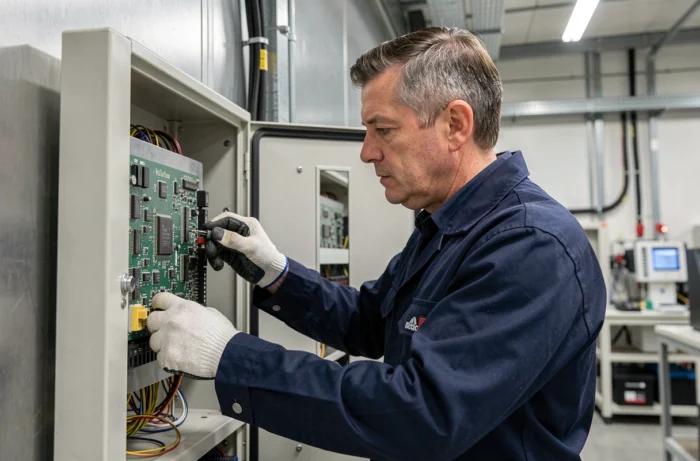
Control-command architectures are evolving faster than equipment renewal cycles. Between the generalization of edge computing modules on DIN rail, the tightening of OT cybersecurity requirements, and the rise of digital twins applied to production lines, the industrial electronics sector is going through a phase where each platform choice commits the operator for a decade. We observe three structuring axes that are reshaping the specifications of integrators and OEMs.
Industrial edge computing and real-time data processing
The massive transfer of raw data to the cloud has never convinced production managers faced with latencies incompatible with the control of critical processes. The dominant trend is to bring computing power closer to the sensor, directly in the electrical cabinet or on the machine chassis.
Embedded controllers capable of executing inference models locally, without relying on a remote server, are changing the value chain. A traditional programmable logic controller was limited to sequential execution. New generations integrate multi-core processors coupled with AI accelerators, allowing predictive maintenance or quality control algorithms to run directly at the field level.
This evolution implies a change in skills for engineering offices. Traditional firmware development is giving way to development environments where automation code (IEC 61131-3) and Linux software containers coexist. Integrators who follow the news on ei-mag.com notice this: tenders increasingly require a dual skill set in automation and software engineering.
OT cybersecurity: normative constraints and impact on electronic design
The IT/OT convergence exposes industrial control systems to attack vectors that were previously confined to office networks. The IEC 62443 standard, which structures the security of industrial automation and control systems, is becoming a prerequisite in tenders for the energy, water, and transport sectors.
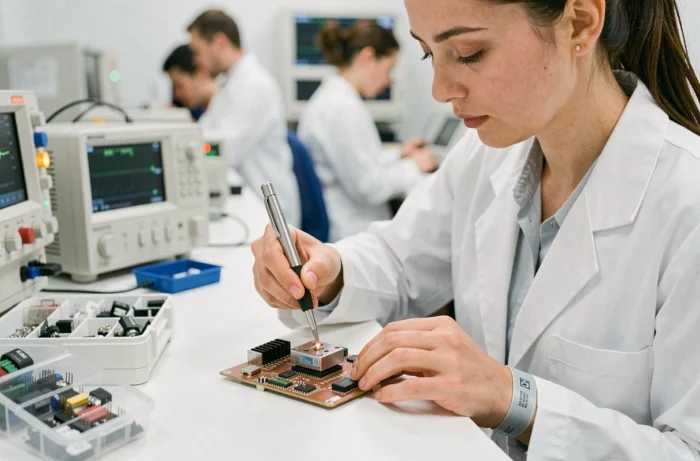
For manufacturers of electronic boards and modules, this translates into concrete requirements from the design phase:
- Integration of secure boot modules with a hardware trust chain to ensure firmware integrity at every power-up.
- Physical segregation of network interfaces on industrial gateways to prevent lateral movement between the supervisory network and the fieldbus.
- Management of the lifecycle of embedded certificates, with OTA (over-the-air) updates compatible with scheduled maintenance windows.
Companies designing equipment without integrating these cybersecurity building blocks from the electronic schematic risk outright rejection during qualification. We recommend anticipating IEC 62443 compliance audits at the prototype stage, not after the pre-series.
Digital twins applied to industrial control systems
The digital twin is no longer reserved for the mechanical simulation of large structures. Its application to industrial electronics is progressing rapidly, particularly for the development of control software before the physical hardware is available.
The principle relies on the behavioral modeling of each component in the control chain: variable speed drive, PLC, sensor, actuator. The engineer tests their control sequences on a virtual model faithful to the electrical and temporal behavior of the actual installation. Parameterization errors, priority conflicts between real-time tasks, or memory capacity overruns appear before the wiring phase.
The economic interest is direct. The time to commission on-site decreases significantly, as the majority of software iterations have already taken place in a simulated environment. For special machines produced in small series, where each day of commissioning weighs heavily on the margin, this approach alters the financial equation of the project.
Interoperability of models and open standards
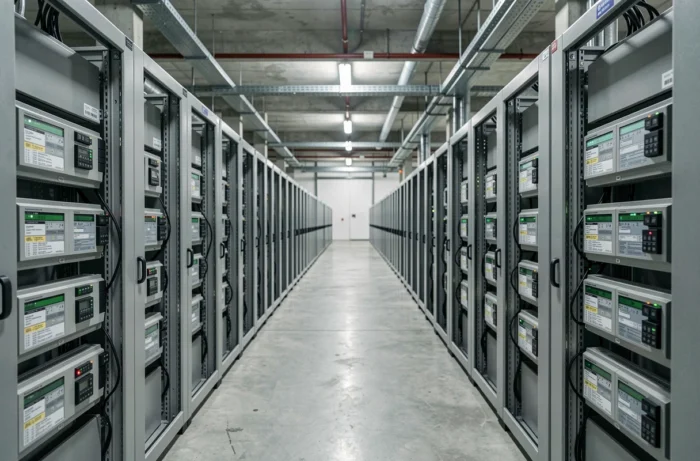
The main obstacle remains the lack of a universal format for component models. Each simulation software vendor offers its own environment, forcing integrators to maintain several parallel libraries. Initiatives around the FMI (Functional Mock-up Interface) standard are attempting to unify model exchanges between tools, but adoption remains uneven among PLC and variable speed drive suppliers.
Predictive maintenance and sensor-software convergence
Predictive maintenance relies on the ability to correlate data streams from heterogeneous sensors: vibration, temperature, absorbed current, spectral analysis. The current trend is moving towards multi-parameter sensors powered by energy harvesting, which can be installed without additional power wiring.
On the software side, maintenance management platforms no longer just display static alert thresholds. Algorithms trained on the operational history of a specific machine dynamically adjust replacement intervals. The shift from calendar-based maintenance to condition-based maintenance reduces both unplanned downtime and spare parts inventory.
The challenge for electronic board manufacturers is to provide standardized communication interfaces (OPC UA, MQTT) directly integrated into measurement modules. An intelligent sensor that only speaks a proprietary protocol loses all value in an open architecture.
The industrial electronics sector is structuring itself around an end-to-end requirement: from the sensor to the digital twin, each component must be interoperable, secure, and capable of processing an increasing share of intelligence locally. The technologies that will prevail in the coming years will be those that reduce the number of software layers between field data and operational decision-making.